
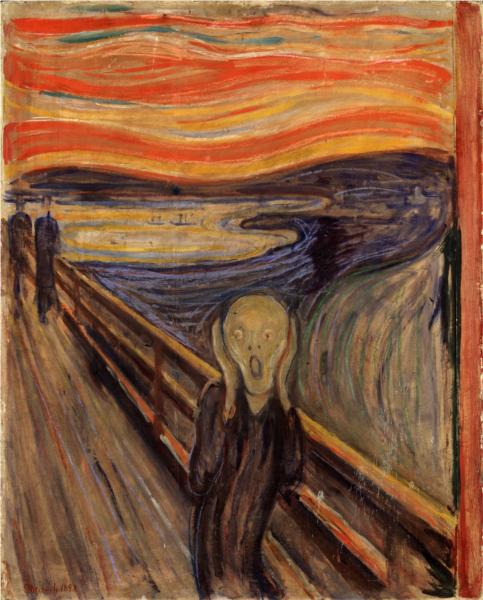
INTRODUCTION: The Birth of Expressionism
Expressionism was more than an art movement—it was a cry from the soul. Emerging in Germany around 1905, it was a reaction against the cold rationality of industrialization and the polished aesthetics of Impressionism. Instead of depicting the world as it appeared, Expressionists sought to portray the world as it felt—distorted, intense, and deeply personal.
The movement peaked during the 1910s and 1920s, especially in the years surrounding World War I, when disillusionment and existential dread permeated society. It flourished across multiple disciplines, from painting and music to architecture and literature.
Key figures included:
- Edvard Munch (Norway), whose haunting The Scream became an icon of emotional turmoil.
- Ernst Ludwig Kirchner, founder of Die Brücke (“The Bridge”), a group of German artists who rejected academic norms.
- Wassily Kandinsky and Franz Marc, members of Der Blaue Reiter (“The Blue Rider”), who explored spiritual abstraction.
- In literature and theater, Georg Kaiser and Ernst Toller gave voice to the psychological and political unrest of the time.
🎨 Expressionism in Painting
Expressionist painters distorted form and color to evoke emotion rather than realism. Their canvases were filled with:
- Jagged lines, bold brushstrokes, and acidic colors
- Themes of urban alienation, spiritual crisis, and inner turmoil
- Figures often appeared elongated, grotesque, or fragmented
Notable works:
- The Scream by Edvard Munch
- Street, Berlin by Ernst Ludwig Kirchner
- Large Blue Horses by Franz Marc
These paintings weren’t meant to soothe, they were meant to provoke, disturb, and awaken.
Expressionism in Music
In music, Expressionism broke away from traditional harmony and structure. Composers used atonality, dissonance, and unpredictable rhythms to reflect psychological states.
Key composers:
- Arnold Schoenberg, pioneer of the 12-tone technique
- Alban Berg, whose opera Wozzeck, above, explored madness and despair
- Anton Webern, known for his sparse, haunting compositions
Expressionist music often felt unsettling, fragmented, and introspective—a sonic mirror of the human psyche.
Expressionism in Fashion
Fashion embraced Expressionism through bold patterns, vivid colors, and asymmetrical silhouettes. Designers used clothing as a canvas for emotional and artistic expression.
Modern echoes of Expressionism can be seen in:
- Vivienne Westwood’s rebellious designs above
- Dries Van Noten’s painterly prints
- Avant-garde fashion that prioritizes emotion over elegance
Expressionist fashion is not about fitting in—it’s about standing out, speaking out, and feeling deeply.
🏛️ Expressionism in Architecture
Expressionist architecture defied symmetry and embraced organic, sculptural forms. Buildings were designed to evoke spirituality, movement, and emotion.
Key examples:
- Einstein Tower by Erich Mendelsohn
- Glass Pavilion by Bruno Taut, above
- Goetheanum by Rudolf Steiner
These structures often resembled crystals, caves, or waves, blurring the line between architecture and sculpture.
📚 Expressionism in Literature
Expressionist literature focused on inner experience, existential angst, and social critique. Writers used fragmented narratives, symbolic characters, and poetic language to explore the human condition.
Notable authors:
- Franz Kafka, whose surreal stories like The Metamorphosis captured alienation
- Georg Trakl, whose poetry was filled with haunting imagery
- Ernst Toller, whose plays reflected political unrest and psychological depth
Expressionist literature was not about plot—it was about emotion, truth, and the struggle to exist.
✨ Conclusion: The Legacy of Expressionism
Expressionism was a movement born from crisis, but it gave rise to radical creativity. It challenged norms, embraced emotion, and laid the groundwork for modern art, literature, and design. Today, its echoes can be felt in everything from abstract painting to experimental theater and fashion runways.
Expressionism reminds us that art is not just about beauty—it’s about feeling, truth, and the human experience in all its raw, unfiltered glory.

2 comentários em “2025InArt #07 Expressionism”