Introduction
At the turn of the 20th century, a sweeping artistic revolution emerged across Europe and beyond: Art Nouveau. This movement, whose name means “new art” in French, sought to break away from historical imitation and instead embrace modernity, nature, and craftsmanship. It flourished between the 1890s and the outbreak of World War I in 1914, a period when industrialization was reshaping society and culture.
The origins of Art Nouveau can be traced to a desire to unify the fine arts and applied arts, creating a “total work of art” (Gesamtkunstwerk) where every detail of life—painting, furniture, fashion, architecture—could be elevated into beauty. Its influences came from natural forms, Japanese prints, Celtic art, and Symbolism.
Major figures included the Czech artist Alphonse Mucha, whose posters became iconic; Belgian architect Victor Horta, pioneer of curved iron and glass design; Catalan genius Antoni Gaudí, who transformed Barcelona’s skyline; and Scottish designer Charles Rennie Mackintosh, known for his blend of minimalism and organic motifs. Together, these artists and thinkers elevated Art Nouveau into one of the most recognizable artistic movements of modern history.
Art Nouveau in Painting
In painting, Art Nouveau rejected rigid academic traditions in favor of flowing lines, ornamental detail, and symbolic imagery. Artists sought to merge fine art with decorative art, creating pieces that were both aesthetic and functional.
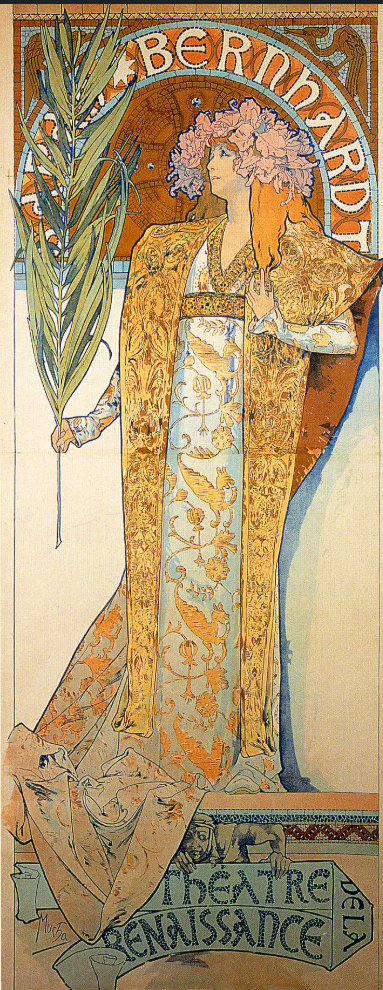
Perhaps the most famous example is Alphonse Mucha, whose posters for theater productions and advertisements defined the Art Nouveau aesthetic: graceful women with long, flowing hair, surrounded by floral motifs, halos, and pastel colors. Mucha’s style became so popular that it was simply known as “le style Mucha” in Paris.
In Austria, Gustav Klimt combined Art Nouveau with Symbolism, producing shimmering works like The Kiss (1907–1908), where gold leaf, abstract patterns, and sensual figures intertwined in ornamental harmony. His membership in the Vienna Secession highlighted how Art Nouveau often intersected with other avant-garde movements.
Art Nouveau in Music
While Art Nouveau is most often associated with visual art and architecture, it also influenced music by aligning with Symbolism and Impressionism in sound. Composers sought to escape rigid classical structures, preferring flowing harmonies and dreamlike atmospheres that paralleled the movement’s visual motifs.
Claude Debussy, though often labeled an Impressionist, expressed Art Nouveau ideals through his free-form compositions and use of exotic scales. Works like Prélude à l’après-midi d’un faune evoke organic movement and fluidity, mirroring the sinuous lines of Mucha’s posters or Gaudí’s architecture.
In Vienna, Gustav Mahler and Alexander Zemlinsky incorporated lush orchestration and emotional intensity that resonated with the movement’s decorative richness. The overlap between Art Nouveau’s visual sensuality and music’s atmospheric qualities created a cultural unity of the arts.
Art Nouveau in Fashion
Fashion during the Art Nouveau period embraced elegance, femininity, and natural forms. Designers and couturiers drew inspiration from the same sinuous curves and floral motifs that characterized painting and architecture.
Silhouettes became more flowing, with softer lines replacing the rigid corseted styles of the late 19th century. Fabrics often featured botanical embroidery, peacock feathers, and stylized floral patterns. Jewelry was particularly important: artists such as René Lalique created breathtaking pieces with dragonflies, orchids, and nymphs made from enamel, opals, and glass.
The emphasis was on wearable art, where clothing and accessories reflected the same organic beauty celebrated across other art forms.
Art Nouveau in Architecture
Architecture is perhaps where Art Nouveau achieved its most spectacular expressions. Architects sought to move away from historic revival styles and instead design buildings that were integrated works of art, where structure, decoration, and furniture worked as one.
In Belgium, Victor Horta pioneered the use of wrought iron, glass, and curving staircases in homes like the Hôtel Tassel (1893–1894), considered one of the first true Art Nouveau buildings. In Barcelona, Antoni Gaudí took the style to new heights with works such as Casa Batlló and the ongoing masterpiece Sagrada Família, both of which feature organic, almost otherworldly forms.
In France, Hector Guimard designed the iconic Paris Métro entrances, instantly recognizable with their green ironwork and plantlike forms. In Scotland, Charles Rennie Mackintosh infused Art Nouveau with geometric precision, balancing organic curves with rectilinear simplicity.
This architectural diversity made Art Nouveau one of the first truly international styles, with distinct interpretations across Europe and beyond.
Art Nouveau in Literature
In literature, Art Nouveau shared strong connections with the Symbolist movement, which emphasized mood, suggestion, and spirituality over realism. Writers and poets sought to capture beauty, mystery, and the subconscious, paralleling the ornamental and dreamlike qualities of Art Nouveau design.
French Symbolist poets like Stéphane Mallarmé and Paul Verlaine deeply influenced the Art Nouveau aesthetic. Their focus on musicality of language, sensual imagery, and ethereal subject matter resonated with artists such as Klimt and Debussy.
In English literature, figures like Oscar Wilde embodied the Art Nouveau spirit with his celebration of beauty and aestheticism. His novel The Picture of Dorian Gray and his essays on art reflect the same desire to merge art with life that defined the movement.