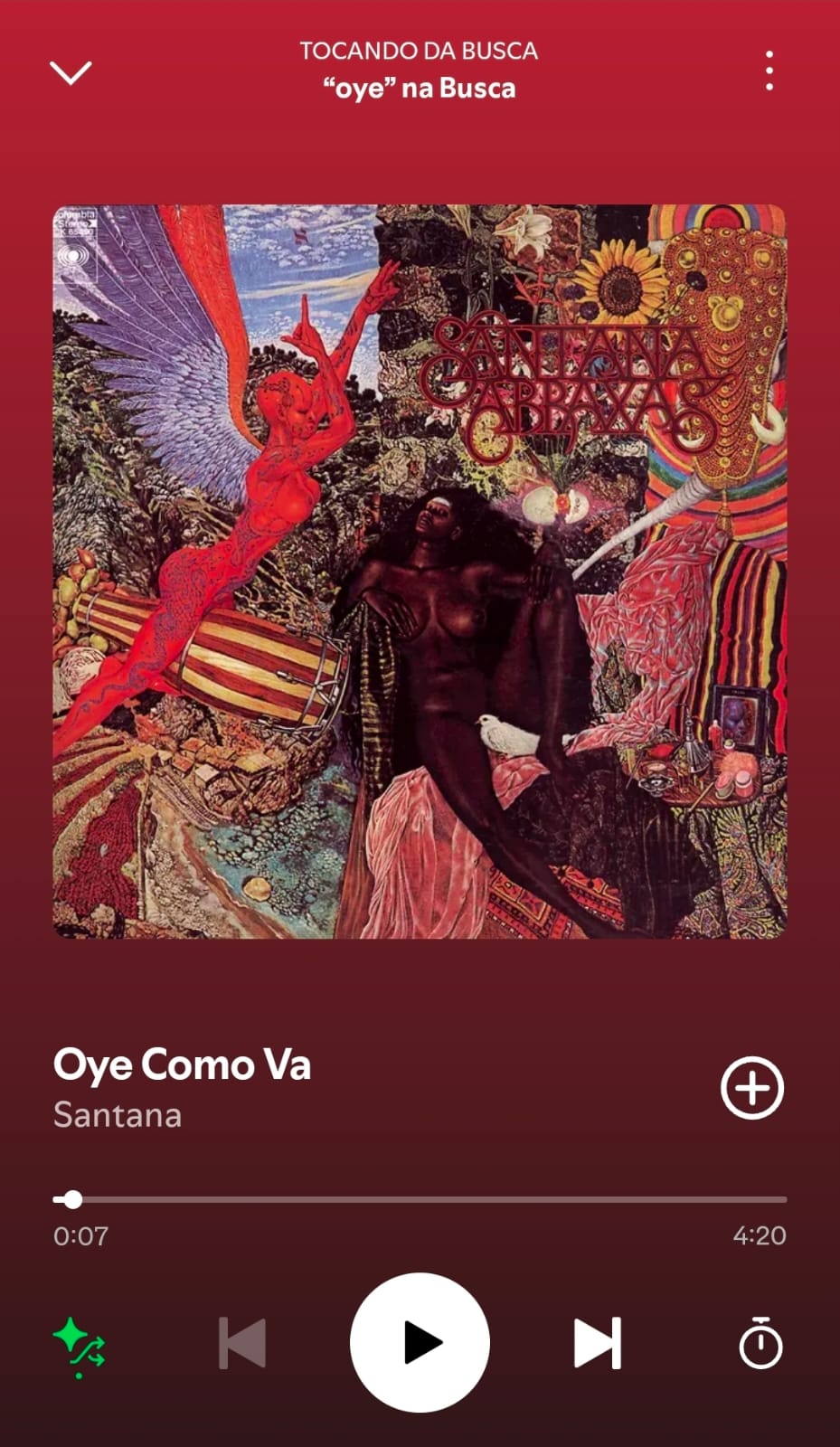
I just stumbled upon a video of Santana and his wife playing this song. No build-up, no intention to analyze anything deeply. Just one of those moments where you click play and suddenly you’re not where you were a few seconds ago. Oye Como Va has that power. It doesn’t ask for attention, it pulls you in.
Santana probably was the first guitarist I listened to as a kid before picking up a guitar myself. I didn’t know what tone was. I didn’t know what sustain meant. I didn’t even know what a guitar solo really was. I just knew that whatever that sound was, it felt alive. Warm. Human. And somehow joyful even when it was intense.
Oye Como Va sits right at the center of that feeling.
A song that travels effortlessly
Originally written by Tito Puente in 1962, Oye Como Va already had a strong Latin identity before Santana ever touched it. But Santana’s 1970 version transformed the song into something borderless. It became Latin rock, psychedelic soul, and radio-friendly groove all at once.
That’s one of Santana’s greatest talents: translation without dilution. He never erased the roots of the music. He amplified them. The percussion stays front and center. The rhythm never apologizes for itself. The guitar doesn’t dominate the song; it dances with it.
Listening to Santana’s version today still feels modern. Not because it sounds contemporary, but because it sounds confident in what it is.
First guitar hero energy
Santana probably was the first guitarist I listened to as a kid before picking up a guitar myself, and that matters more than technical influence. He wasn’t fast in a flashy way. He wasn’t aggressive. He didn’t overwhelm you with notes. He made the guitar sing.
For a kid, that’s powerful. It tells you the instrument is expressive, not intimidating. That it can speak emotionally without shouting. Oye Como Va was an open door. It didn’t say “look how good I am.” It said “come closer.”
That kind of influence stays with you.
The joy in repetition
Oye Como Va doesn’t change much from beginning to end, and that’s exactly why it works. The groove locks in early and stays there. Instead of building tension, it builds comfort.
The organ riff repeats like a mantra. The percussion maintains a steady, hypnotic pulse. Santana’s guitar floats above it all, repeating simple melodic ideas with subtle variation. It’s not about where the song goes. It’s about staying where it is.
That’s a very Latin concept. Rhythm as a place, not a journey.
Talk nerdy to me: a music theory perspective
From a music theory perspective, Oye Como Va is built on a deceptively simple harmonic foundation. The song revolves around a two-chord vamp, typically A minor to D7, which creates a modal feel rather than a traditional functional progression. This vamp establishes a Dorian-like environment, allowing Santana’s guitar to emphasize melodic phrasing over harmonic movement. Rhythmically, the song is anchored in a Latin groove driven by percussion, clave-influenced patterns, and syncopation, while the drum kit reinforces rather than leads. Santana’s lead lines rely heavily on pentatonic and modal scales, focusing on sustain, bends, and vibrato instead of speed. The lack of harmonic complexity gives the melody space to breathe, making every note feel intentional. It’s a perfect example of how limitation can create freedom.
Watching Santana play it now
That video of Santana and his wife playing Oye Como Va hits differently. Not because it’s flashy or technically impressive, but because it feels intimate. Like two people sharing a language they’ve spoken together for a long time.
There’s something reassuring about seeing a song age alongside the person who made it famous. Santana doesn’t fight time. He moves with it. His playing is slower now, more spacious, but just as expressive.
It’s a reminder that music isn’t about peak performance. It’s about continuity.
Santana as a bridge
Santana has always been a bridge. Between Latin music and rock. Between spirituality and groove. Between technical musicianship and emotional accessibility.
Oye Como Va might be the clearest example of that role. It doesn’t explain itself. It doesn’t translate anything verbally. It just lets rhythm and melody do the work.
That’s why it still shows up everywhere. Movies. Radio. Live jams. YouTube rabbit holes you didn’t plan to fall into.
Three more Santana songs worth revisiting
If Oye Como Va resonates with you, here are three more Santana songs that capture different sides of his artistry:
- Black Magic Woman
A fusion of blues and Latin rhythm that showcases Santana’s ability to turn a familiar song into something entirely his own. - Samba Pa Ti
One of his most emotional instrumental performances, built almost entirely on phrasing, sustain, and melodic patience. - Europa (Earth’s Cry Heaven’s Smile)
A slow-burn guitar piece that highlights Santana’s lyrical approach to soloing and his deep connection to melody.
Why this song still matters
Oye Como Va doesn’t age because it doesn’t chase relevance. It exists in a groove that feels timeless. It reminds you that music doesn’t need complexity to be deep, and it doesn’t need speed to be powerful.
For me, it connects the moment I first heard Santana as a kid with the moment I randomly clicked a video online years later. Same song. Same feeling. Different context.
And that’s the mark of something truly lasting.