
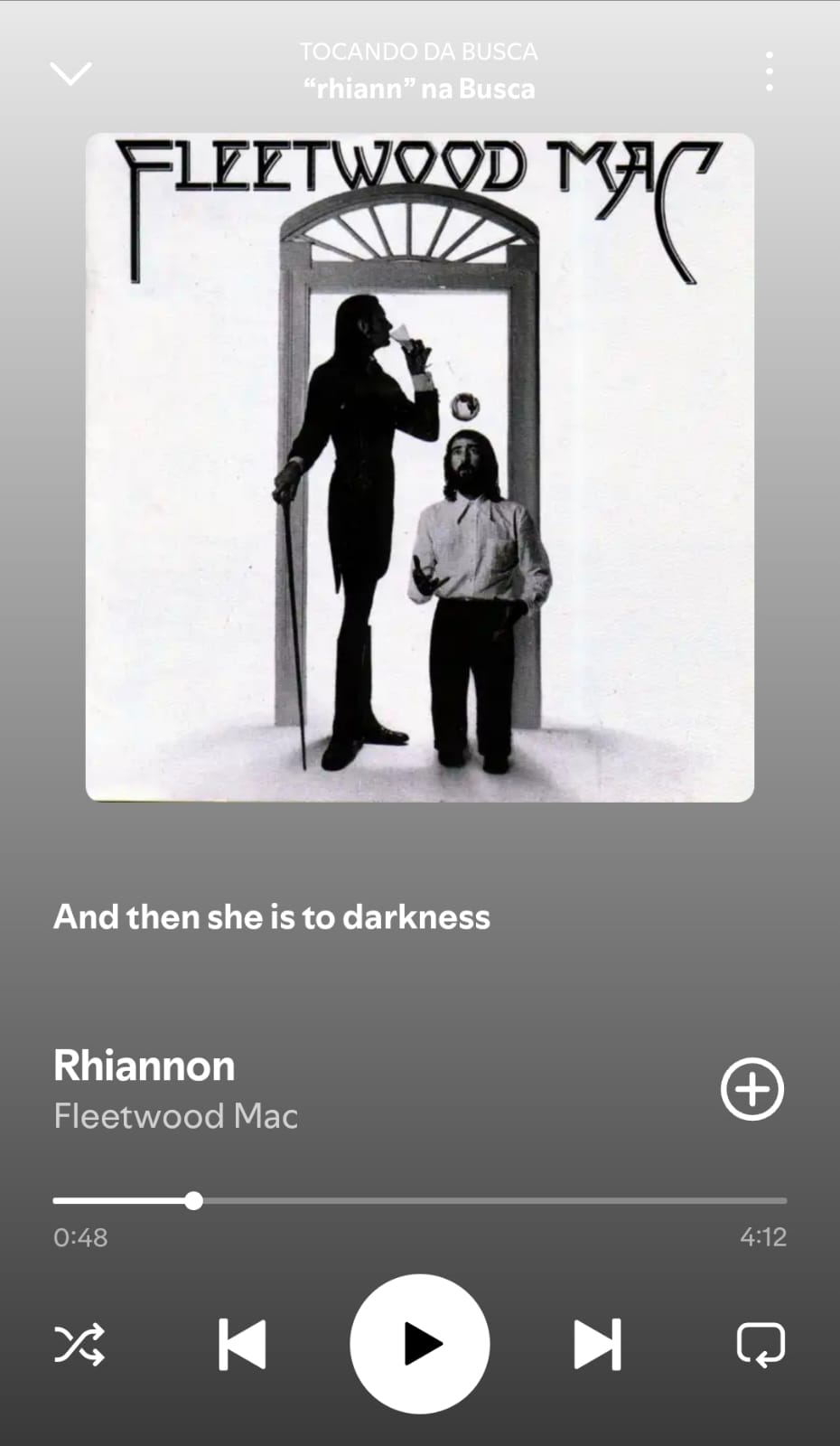
There are songs that simply play, and there are songs that seem to exist somewhere else entirely, waiting for you to stumble into them at the right moment. Rhiannon sits comfortably in that second category. Released in 1975 as part of Fleetwood Mac’s self-titled album, the song marked a turning point not just for the band, but for Stevie Nicks as a songwriter and performer. It is one of those tracks that feels bigger than its runtime. Mysterious, haunting, and strangely intimate all at once.
Rhiannon was not born as a song at first. Stevie Nicks found the name in a novel by Mary Leader, where Rhiannon appeared as a character loosely inspired by Welsh mythology. Later, Nicks discovered the deeper mythological roots of the name, a powerful and otherworldly woman tied to transformation and independence. That only reinforced the aura the song already carried. Even before knowing the full myth, she had tapped into something archetypal.
Fleetwood Mac in 1975 was also in the middle of its own transformation. Lindsey Buckingham and Stevie Nicks had just joined the band, reshaping its sound from blues-rooted rock into something more atmospheric and emotionally layered. Rhiannon became one of the earliest signals that this new lineup was not just a continuation. It was a reinvention.
The atmosphere that defines a generation
From the very first notes, Rhiannon does not rush to introduce itself. It drifts in. The electric piano sets a soft, almost hypnotic foundation, while the guitar lines shimmer in the background without overwhelming the mix. Mick Fleetwood’s drumming is restrained but purposeful, giving the song a pulse rather than a push.
And then there is Stevie Nicks’ voice.
Her delivery is what transforms Rhiannon from a well-written song into something myth-like. She does not just sing the lyrics. She inhabits them. There is a sense of storytelling, but also a sense that she is discovering the story as she goes. Lines like “She is like a cat in the dark” do not feel like distant metaphors. They feel observational, as if the character is real and just slightly out of reach.
This is part of what made Fleetwood Mac stand out in that era. While many bands leaned into either polished pop or raw rock energy, they found a balance between emotional vulnerability and sonic texture. Rhiannon lives in that balance.
The live performances that changed everything
If the studio version introduced Rhiannon, the live performances turned it into something much bigger.
Throughout the late 70s, especially during the Rumours tour, Stevie Nicks extended the song into a more theatrical experience. The tempo would stretch, the vocals would become more intense, and the ending often dissolved into a kind of controlled chaos. Part improvisation, part ritual. These performances gave the song a second life, one that arguably surpassed the original recording.
It is worth noting that this was not just about vocal power. It was about presence. Nicks turned Rhiannon into a character on stage, blurring the line between performer and persona in a way that felt natural rather than forced.
More from Fleetwood Mac
- Dreams – brings a more minimal and hypnotic approach, built around a steady groove and one of Stevie Nicks’ most recognizable vocal performances. It shows how less can truly be more when every element has space to breathe. Read more about the song Dreams here.
- Go Your Own Way – highlights Lindsey Buckingham’s songwriting style, with driving guitars and a more direct emotional edge. It contrasts with Rhiannon by trading mysticism for raw relationship tension.
- The Chain – stands out as a full-band statement, famous for its slow build and powerful final section driven by John McVie’s bassline. It captures the chemistry and conflict that defined the group at their peak.
Talk nerdy to me: music theory behind Rhiannon
For beginner musicians and producers, Rhiannon offers a subtle but powerful lesson in how simplicity can create depth. The song is primarily built around a repeating chord progression in the key of A minor, often cycling through Am, F, C, and G. This progression is a classic example of modal interchange within a natural minor framework, giving the track its melancholic yet fluid emotional tone.
What makes it compelling is not complexity, but consistency. The cyclical nature of the chords reinforces the hypnotic quality of the song, allowing listeners to sink into the groove rather than anticipate constant change. Lindsey Buckingham’s guitar work complements this by emphasizing arpeggiated patterns and sustained tones instead of aggressive strumming, which preserves the song’s airy texture.
Rhythmically, the track sits at a moderate tempo, roughly around 104 beats per minute, but it feels slower due to the spacing between instrumental phrases and the laid-back drum groove. Mick Fleetwood avoids overplaying, using minimal fills and focusing on steady hi-hat patterns and soft snare accents. This restraint creates space for the vocals to lead the emotional narrative.
Another key element is dynamics. The song gradually builds without dramatic shifts between sections. Instead of a traditional explosive chorus, Rhiannon relies on subtle layering. Additional harmonies, slightly stronger vocal projection, and more pronounced instrumentation create a sense of lift. This is a great example of how dynamic contrast does not always require volume. It can come from texture and phrasing.
The cultural footprint of Rhiannon
Over the decades, Rhiannon has remained one of Fleetwood Mac’s most recognizable songs. It is not just because it was a hit. It is because it feels timeless. The themes of independence, mysticism, and feminine power resonate across generations, and the song never feels tied to a specific era despite its 70s production.
It has also become a defining piece of Stevie Nicks’ identity as an artist. Even in her solo career, the aesthetic and emotional threads introduced in Rhiannon continue to appear. Flowing imagery, layered vocals, and a sense of storytelling rooted in myth and personal experience all trace back here.
Interestingly, the song’s longevity also comes from its adaptability. It works in its original form, in stripped-down acoustic versions, and in extended live renditions. That flexibility is usually a sign of strong songwriting at its core.
Why it still matters
Rhiannon is not just a song you listen to. It is a song you revisit. It changes slightly depending on when you hear it and what you bring into it. Sometimes it feels calming, sometimes eerie, sometimes empowering.
That is the mark of something well-crafted but also emotionally open-ended.
Fleetwood Mac had many hits, and Rumours would go on to overshadow almost everything else in their catalog commercially. But Rhiannon remains a cornerstone because it captures a moment where everything aligned. A new band dynamic, a unique voice finding its footing, and a sound that did not try too hard to explain itself.
It simply existed. And it still does.