
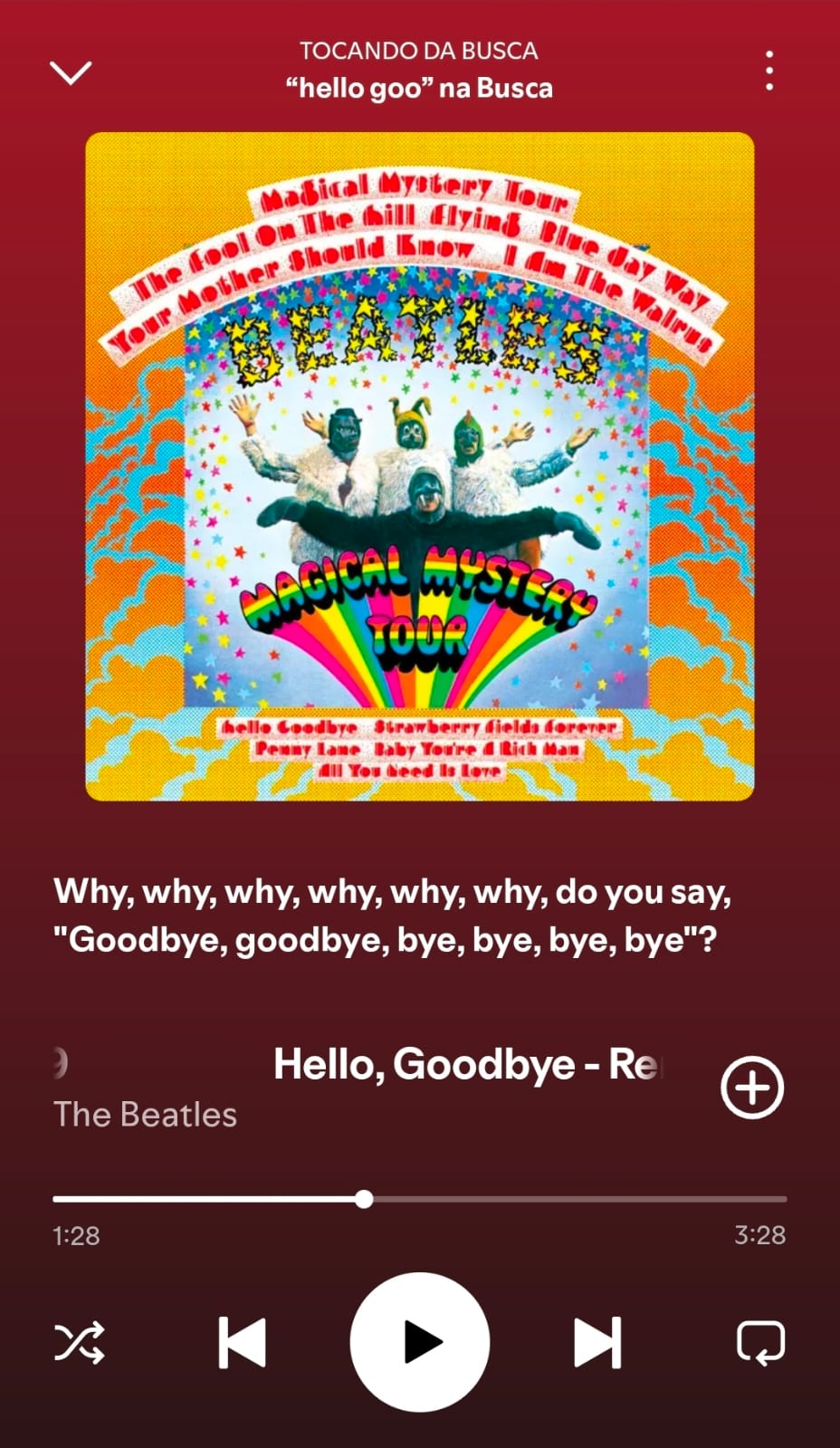
Some songs somehow become more meaningful depending on the moment you hear them. “Hello, Goodbye” by The Beatles is one of those songs.
Today, the track feels especially fitting because of the finale of The Late Show with Stephen Colbert. A title built around endings and beginnings suddenly carries emotional weight in a completely different way. “Hello, Goodbye” has always been playful on the surface, but underneath the catchy chorus is a song deeply connected to transitions, contradictions, and the strange emotional space between holding on and letting go.
That emotional duality is exactly what makes the song timeless.
Released in 1967 during one of the most creatively explosive periods in music history, “Hello, Goodbye” arrived at a fascinating point in The Beatles’ evolution. The band had already transformed from straightforward pop stars into boundary-pushing studio innovators. Albums like Revolver and Sgt. Pepper’s Lonely Hearts Club Band completely reshaped expectations for what pop music could sound like.
And yet “Hello, Goodbye” remained deceptively simple.
At first listen, the song feels cheerful, lighthearted, and almost childlike. But like many Beatles songs, the simplicity hides remarkable craftsmanship underneath.
The Charm of Simplicity
One reason “Hello, Goodbye” continues to resonate with listeners is its accessibility. Unlike some of The Beatles’ more experimental work, the song immediately welcomes the audience in.
The lyrics revolve around opposites: hello and goodbye, yes and no, stop and go. The structure feels almost conversational, like a playful argument unfolding through melody. That simplicity gives the song universal appeal because everyone understands contrast and contradiction.
At the same time, the repetition creates hypnotic momentum.
The Beatles understood something many songwriters forget: simple ideas become powerful when executed with confidence and personality. “Hello, Goodbye” never tries to overwhelm the listener with complexity. Instead, it focuses on rhythm, melody, and emotional warmth.
Paul McCartney’s vocal performance plays a huge role in that effect. His delivery feels energetic and inviting, giving the song a sense of optimism even when the lyrics hint at confusion and emotional distance.
The contrast between emotional uncertainty and musical brightness creates much of the song’s magic.
The Beatles at Their Creative Peak
By 1967, The Beatles were operating on a completely different creative level from most pop groups of the era.
They were no longer simply writing songs for radio success. They were experimenting constantly with recording techniques, instrumentation, arrangement structures, and lyrical themes. The studio itself became part of the songwriting process.
“Hello, Goodbye” reflects that freedom.
Even though the track sounds straightforward, the production contains countless subtle details. Layered harmonies, shifting textures, dynamic percussion, and carefully arranged transitions all contribute to making the song feel alive and constantly moving.
The ending section is especially memorable. The repeated “Hela, hey ba hello-a” coda transforms the track from structured pop song into something almost ritualistic and celebratory. It feels spontaneous while still being tightly controlled musically.
That balance between looseness and precision became one of The Beatles’ defining strengths during their later years.
Why the Song Still Feels Fresh
Many songs from the 1960s sound tied to their era. “Hello, Goodbye” somehow avoids that problem.
Part of the reason is emotional clarity. The themes of contradiction, communication, and transition are timeless. Another reason is the production itself. Unlike heavily trend-dependent songs, “Hello, Goodbye” relies primarily on melody and rhythm rather than gimmicks.
The song also benefits from emotional openness. Listeners can interpret it in multiple ways depending on their own experiences. Some hear optimism. Others hear frustration. Some hear innocence while others hear emotional miscommunication.
That flexibility allows the song to evolve emotionally across generations.
And today, with the end of The Late Show with Stephen Colbert, the title alone suddenly feels emotionally loaded. Endings in entertainment often create strange collective nostalgia. “Hello, Goodbye” captures that feeling perfectly because it understands that every goodbye usually contains the possibility of another hello somewhere else.
Talk nerdy to me
From a music theory perspective, “Hello, Goodbye” is a brilliant example of how contrast can drive an entire song.
The composition constantly plays with opposites, not just lyrically but musically. The verses move with tight melodic phrasing and rhythmic control, while the chorus opens up harmonically and emotionally. This creates a satisfying push-and-pull dynamic throughout the track.
The chord progression feels bright and energetic, largely because of its major tonal center and smooth harmonic movement. The Beatles frequently used accessible harmonic structures but enhanced them with unexpected melodic choices and vocal layering.
Rhythmically, the song maintains forward momentum through syncopated accents and dynamic percussion patterns. The groove feels playful rather than aggressive, which reinforces the conversational tone of the lyrics.
The vocal harmonies are another key element. Like many Beatles songs, the layering of voices creates warmth and richness without sounding overly polished. The imperfections actually make the performance feel more human.
The ending coda is especially fascinating musically because it gradually shifts the emotional atmosphere from structured pop into communal chant-like repetition. This transition gives the song a celebratory release after the tension created by the lyrical contradictions earlier in the track.
For songwriters, “Hello, Goodbye” remains an incredible lesson in how simplicity, repetition, and contrast can create lasting emotional impact.
Why The Beatles Still Matter
I know to write this is kinda idiotic because, of course, it’s the Beatles, but it’s for SEO sake: It is impossible to discuss modern pop and rock music without acknowledging the influence of The Beatles. Their impact extends beyond hit songs or album sales. They fundamentally changed how artists approached songwriting, recording, and creative identity.
Before The Beatles, pop music was often treated as disposable entertainment. After them, albums became artistic statements. Studio experimentation became mainstream. Songwriters gained greater creative control.
“Hello, Goodbye” might not always receive the same critical attention as songs like “A Day in the Life” or “Strawberry Fields Forever,” but it represents something equally important: The Beatles’ ability to make sophisticated songwriting feel effortless.
That accessibility helped them connect with millions of listeners across generations and cultures.
Three More Beatles Songs You Should Listen To
If “Hello, Goodbye” made you want to revisit The Beatles, these songs are perfect companions.
1. “Penny Lane”
A bright, melodic masterpiece filled with vivid imagery and intricate arrangement details. “Penny Lane” captures nostalgia and optimism beautifully.
2. “Strawberry Fields Forever”
One of the band’s most experimental and emotionally layered songs. The dreamlike production and surreal structure completely changed psychedelic pop music.
3. “All You Need Is Love”
Another Beatles anthem built around simplicity and universal emotional connection. The song remains one of the most recognizable peace-driven pop tracks ever written.
Why “Hello, Goodbye” Endures
Not every Beatles song became timeless for the same reason. Some survived because of innovation. Others survived because of emotional depth or cultural importance.
“Hello, Goodbye” survives because it feels human.
The song understands that life is filled with contradictions. People say yes when they mean no. Relationships begin while others end. Goodbyes often arrive mixed with hope, uncertainty, relief, sadness, and excitement all at once.
The Beatles captured that emotional complexity inside a song that still sounds joyful decades later.
And today, as audiences say goodbye to a familiar late-night institution through the finale of The Late Show with Stephen Colbert, “Hello, Goodbye” somehow feels like the perfect soundtrack for the moment.