There is something almost impossible about the sun.
Not impossible in the literal sense, obviously—it is there every day, predictable, indifferent, constant. But impossible in the sense that it resists being fully understood as an image. We know what it is, scientifically. A star. Nuclear fusion. Heat, light, gravity. But none of that explains why it still feels symbolic.
Maybe because long before humanity understood the mechanics of the sun, it understood its power.
Civilizations worshipped it. Built monuments aligned to it. Timed their rituals by it. Entire gods were shaped around its movement. Ra in Egypt, Helios in Greece, Amaterasu in Japan. The sun was never just celestial; it was divine.
And even now, in a secular age, it continues to function that way in art.
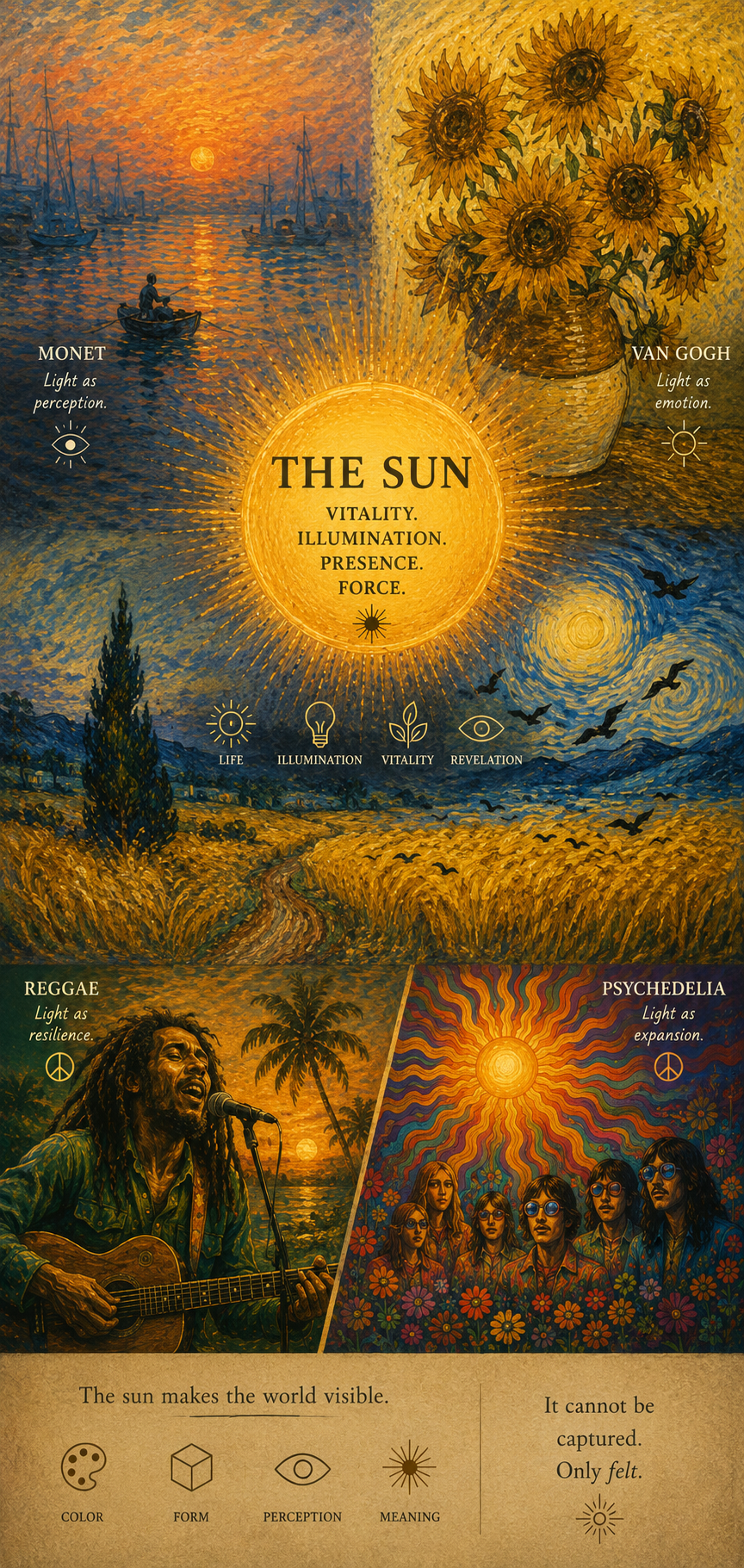
The sun in art remains one of the oldest and most persistent symbols of vitality, illumination, and transcendence. Not simply because it lights the world, but because it makes the world visible. Without it, form disappears. Color disappears. Meaning itself feels harder to grasp.
For painters, this makes the sun less an object than a condition. It is not something you paint—it is what allows painting to exist at all.
That alone makes it the ultimate source of inspiration.
The Sun as Absolute Presence
Unlike the moon, which borrows light, the sun generates it. That difference matters symbolically.
The moon suggests reflection, mystery, emotional tides. The sun suggests certainty. Presence. Force. It is direct. It does not negotiate.
This explains why so much artistic symbolism surrounding the sun is tied to vitality and illumination. The sun represents energy in its purest form—physical, spiritual, intellectual.
To “see the light” remains one of the most universal metaphors for understanding.
And yet, the sun is not always gentle.
It nourishes, but it can also burn. It reveals, but it can also blind. This duality makes it artistically compelling. It is both life-giving and overwhelming.
And perhaps no artistic movement understood this better than Impressionism.
Monet and the Fragility of Sunlight
Claude Monet did not paint objects so much as he painted the conditions around them. Light, atmosphere, time. His obsession was less with permanence and more with perception itself.
That becomes especially clear in works like Setting Sun.
The subject seems simple enough: a sun descending toward the horizon. But in Monet’s hands, the sun becomes unstable. Its edges dissolve into surrounding color. The sky shifts between warmth and vapor. Reflection interrupts form.
What matters is not the sun itself, but what it does to everything around it.
This is one of the most important developments in the history of the sun in art. Before Impressionism, the sun often functioned symbolically or compositionally. With Monet, it became experiential.
The viewer no longer observes sunlight—they feel it.
That subtle shift changed painting forever.
Impressionism understood something radical: light is never fixed. It changes by the second. Which means reality itself is unstable. The world you see at sunrise is not the same world you see at dusk.
That realization feels almost philosophical.
And Monet opened the door for someone who would push the sun into something even more emotionally explosive.
Van Gogh.
Van Gogh and the Violence of Vitality
It is difficult to talk about the sun in art without arriving at Vincent van Gogh.
His sun is not passive.
Where Monet observed light, Van Gogh attacked it.
The most obvious example is his Sunflowers series. At first glance, they seem like studies of flowers. But they are really studies of solar energy. The yellow is excessive, almost aggressive. It pulses. It vibrates. It consumes the canvas.
Read more about the color yellow itself in my post about it here.
These are not flowers resting under sunlight.
They are extensions of it.
Van Gogh understood yellow as few painters ever did—not simply as color, but as emotion. His sunlit fields, his burning skies, his golden wheat all feel electrically alive. Even when depicting stillness, there is movement inside the paint itself.
That is the strange genius of Van Gogh.
His use of sunlight transforms vitality into something almost unstable. Life appears beautiful, but it also appears overwhelming. Too intense to hold comfortably.
This tension appears even in works like Wheatfield with Crows. The sky glows, but the energy feels restless, almost apocalyptic.
The sun, here, is no longer divine in the traditional sense.
It becomes psychological.
An external force reflecting internal chaos.
And honestly, that may be closer to how modern people experience illumination anyway.
Not as peace.
But as intensity.
The Sound of Sunshine: Reggae and Psychedelic Optimism
The symbolic power of the sun extends naturally into music.
Some genres feel sunlit even without mentioning the sun directly.
Reggae is one of them.
Emerging from Jamaica, reggae carries an unmistakable relationship with warmth, rhythm, and light. Its syncopated grooves feel spacious, almost like breathing under an open sky. Even when dealing with political struggle or spiritual resistance, reggae often maintains an undercurrent of optimism.
That optimism feels solar.
Artists like Bob Marley turned sunlight into emotional atmosphere. Songs about liberation, love, and spiritual consciousness often feel illuminated from within. Not naive, but resilient.
Light here becomes endurance.
The sun as survival.
And then there is the psychedelic explosion of the 1960s.
Unlike reggae’s grounded warmth, psychedelic music treated sunlight almost as sensory overload. Bright guitars, swirling organs, distorted colors translated into sound. Bands like The Beatles during their late period, or The Beach Boys in Pet Sounds and beyond, explored sonic landscapes drenched in brightness.
It was sunshine as hallucination.
The Summer of Love itself was built around solar imagery: flowers, warmth, daylight, expansion. The sun symbolized freedom, consciousness, and collective awakening.
Again, illumination.
But filtered through psychedelia, illumination becomes excess.
Too much color. Too much sensation. Too much light.
Which is maybe what makes it feel so alive.
A Retro Link: The Return of Impressionism
It is interesting that in 2025, conversations around art have returned so heavily to Impressionism.
Not because it is fashionable, but because it feels newly relevant.
Impressionism was always about instability—about how light alters perception moment by moment. In a world increasingly shaped by speed, digital fragmentation, and endless visual stimuli, that sensitivity feels contemporary again.
And the sun sits at the center of that return.
Without sunlight, Impressionism collapses.
Monet understood this. Van Gogh transformed it.
And modern audiences, perhaps unconsciously, keep returning to these works because they offer something rare: attention to presence.
Not grand narratives. Not fixed truths.
Just light, existing for a moment.
And maybe that is enough.
The Eternal Source
What makes the sun such a powerful artistic symbol is not simply that it gives life.
It gives visibility.
It makes color possible. Form possible. Perception possible.
Without it, the world remains hidden.
That is why the sun continues to represent illumination—not just physically, but intellectually and spiritually. To encounter the sun in art is often to encounter the idea of revelation itself.
Sometimes peaceful, like Monet.
Sometimes violent, like Van Gogh.
Sometimes rhythmic, like reggae.
Sometimes ecstatic, like psychedelia.
But always transformative.
The sun does not ask for attention.
It commands it.
And maybe that is why artists have never stopped trying to paint it.
Not because it can be captured.
But because it cannot.