
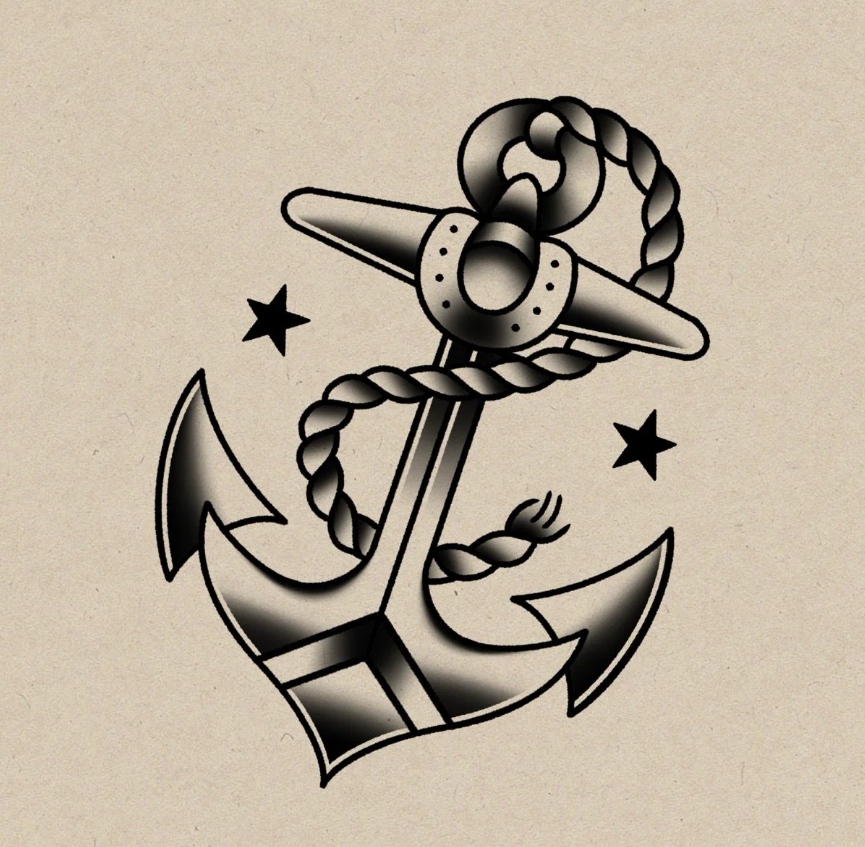
An anchor is one of those objects that most people recognize instantly but rarely think about deeply.
It is heavy, practical, and designed for a single purpose. It disappears beneath the water, often completely out of sight, and yet its absence is immediately felt. Ships do not celebrate their anchors. They simply trust them.
Perhaps that is why the meaning of the anchor has endured for centuries. It is less about the object itself than about what it quietly promises. Security. Stability. The possibility of remaining grounded when everything else is moving.
In art, symbols often become powerful because they speak to experiences that are difficult to explain directly. The anchor belongs to that category. It represents hope without sentimentality. Confidence without spectacle. It reminds us that strength is not always visible.
After all, what keeps us steady during a storm is rarely the thing everyone notices.
More Than a Nautical Tool
At first glance, the anchor seems inseparable from the sea. It belongs to sailors, harbors, and long voyages. Its shape immediately evokes ships and oceans.
But symbols rarely remain tied to their original function.
The nautical symbolism of the anchor gradually expanded into something much broader. As maritime exploration became central to human history, the anchor evolved into a metaphor for endurance, safe return, and emotional resilience. Every voyage carried uncertainty. Every departure involved risk. The anchor represented the comforting possibility that there would be a place to stop.
Unlike a compass, which encourages movement, or a sail, which depends on the wind, the anchor exists for moments of stillness.
That distinction matters.
Modern culture often celebrates constant motion. We admire speed, progress, reinvention, and endless productivity. Remaining still is frequently mistaken for standing still.
The anchor quietly argues the opposite.
Sometimes the strongest decision is not to move.
The Anchor in Early Christian Art
Long before it became a popular tattoo or a decorative motif, the anchor carried profound spiritual significance.
In the earliest centuries of Christianity, believers often practiced their faith under persecution. Open religious imagery could be dangerous, so symbolic language became essential. Among the fish, the dove, and the shepherd, the anchor emerged as one of the most meaningful visual signs.
Its symbolism came partly from scripture. The Epistle to the Hebrews describes hope as “an anchor for the soul, firm and secure.” It is an image that has survived for nearly two thousand years because of its remarkable simplicity.
Hope, in this context, is not optimism.
It is stability.
Early Christian art frequently depicted anchors carved into tombs, engraved on rings, or incorporated into catacomb paintings. Sometimes the shape subtly resembled a cross, allowing the symbol to communicate faith without immediately revealing itself.
That dual identity made the anchor particularly powerful.
It suggested salvation without triumphalism. Quiet confidence rather than dramatic certainty.
Interestingly, this symbolism also transformed the sea itself. Water had long represented chaos, danger, and the unknown. The anchor became the element capable of resisting those forces.
Not by defeating the storm.
But by remaining firm within it.
That distinction feels surprisingly modern.
From Sacred Symbol to Old School Icon
Centuries later, the anchor found a completely different audience.
By the late nineteenth and early twentieth centuries, it had become one of the defining images of maritime tattoo culture. Sailors returning from long voyages often marked their bodies with anchors as symbols of experience, survival, and safe passage.
Eventually, the image became central to what we now recognize as the Old School tattoo aesthetic.
Bold black outlines. Limited but vibrant colors. Simple compositions designed to remain legible over time.
Alongside swallows, roses, ships, and hearts, the anchor became one of the movement’s most recognizable motifs.
Its meaning shifted once again.
For sailors, an anchor could commemorate crossing the Atlantic, surviving dangerous waters, or simply maintaining a connection to life at sea. Over time, however, the symbol expanded beyond maritime identity. It came to represent loyalty, commitment, and emotional grounding.
Even people who had never stepped aboard a ship understood its message.
Everyone knows what it feels like to search for stability.
What makes Old School tattooing fascinating is its ability to transform practical objects into emotional symbols. An anchor is no longer just forged metal. It becomes memory.
It becomes identity.
The Rhythm That Holds Everything Together
The symbolism of the anchor extends naturally into music, although not in a literal sense.
Every great musical performance depends on elements that often receive less attention than the melody.
The bass and the drums rarely occupy the spotlight. Audiences tend to remember vocal lines, guitar solos, or dramatic choruses. Yet remove the rhythm section, and the entire structure begins to collapse.
In many ways, the bassist functions as the anchor of a band.
The instrument connects harmony and rhythm, creating a bridge between melody and percussion. Bass notes provide weight. They define movement while simultaneously creating stability.
Listeners may not always notice the bass consciously.
They almost always notice its absence.
The drummer performs a similar role.
Rather than dominating the musical conversation, the drums establish the pulse that allows every other instrument to breathe together. Tempo becomes a form of trust. Musicians rely on it without constantly acknowledging it.
This is why rhythm sections are often described as the foundation of a song.
Not because they are louder.
Because they are dependable.
The comparison with an anchor feels almost inevitable.
Both operate beneath the surface.
Both create confidence through consistency rather than spectacle.
Perhaps this explains why some of the greatest rhythm sections in music history developed extraordinary chemistry. They understood that their purpose was not individual brilliance but collective balance.
Like an anchor beneath the sea, their greatest work often remained invisible.
Stability in an Age of Constant Motion
The modern world has a complicated relationship with stability.
Technology encourages constant updates. Careers evolve rapidly. Trends appear and disappear within weeks. Even identity increasingly feels flexible rather than fixed.
Adaptability has become one of our highest virtues.
And rightly so.
Yet symbols like the anchor continue to resonate because they remind us that flexibility alone is not enough.
Movement requires orientation.
Progress requires something worth returning to.
Without stability, motion eventually becomes drift.
Perhaps this explains why the anchor continues appearing in contemporary design, jewelry, fashion, literature, and visual culture. It communicates reassurance without excessive sentimentality. It acknowledges uncertainty while refusing surrender.
It suggests that security is not the absence of storms.
It is the presence of something capable of holding through them.
That message feels remarkably timeless.
What Keeps Us Grounded
The most interesting thing about an anchor is that it only fulfills its purpose when hidden.
Once deployed, it disappears beneath the water, completely out of view. The ship remains visible. The sea remains visible. The storm remains visible.
The anchor does not.
And yet it is the reason everything else remains where it should.
Perhaps that is why the meaning of the anchor continues to endure across centuries of art and culture. It speaks to the quiet forces that shape our lives without demanding recognition.
Faith.
Trust.
Friendship.
Love.
Discipline.
Memory.
These are rarely the loudest parts of a life, but they are often the strongest.
The anchor reminds us that stability is not dramatic. It is patient.
Not rigid, but resilient.
Not about resisting every wave, but about knowing where to hold.
And maybe that is the most hopeful lesson the symbol has to offer.
The strongest foundations are often the ones no one sees.
Until the storm arrives.