
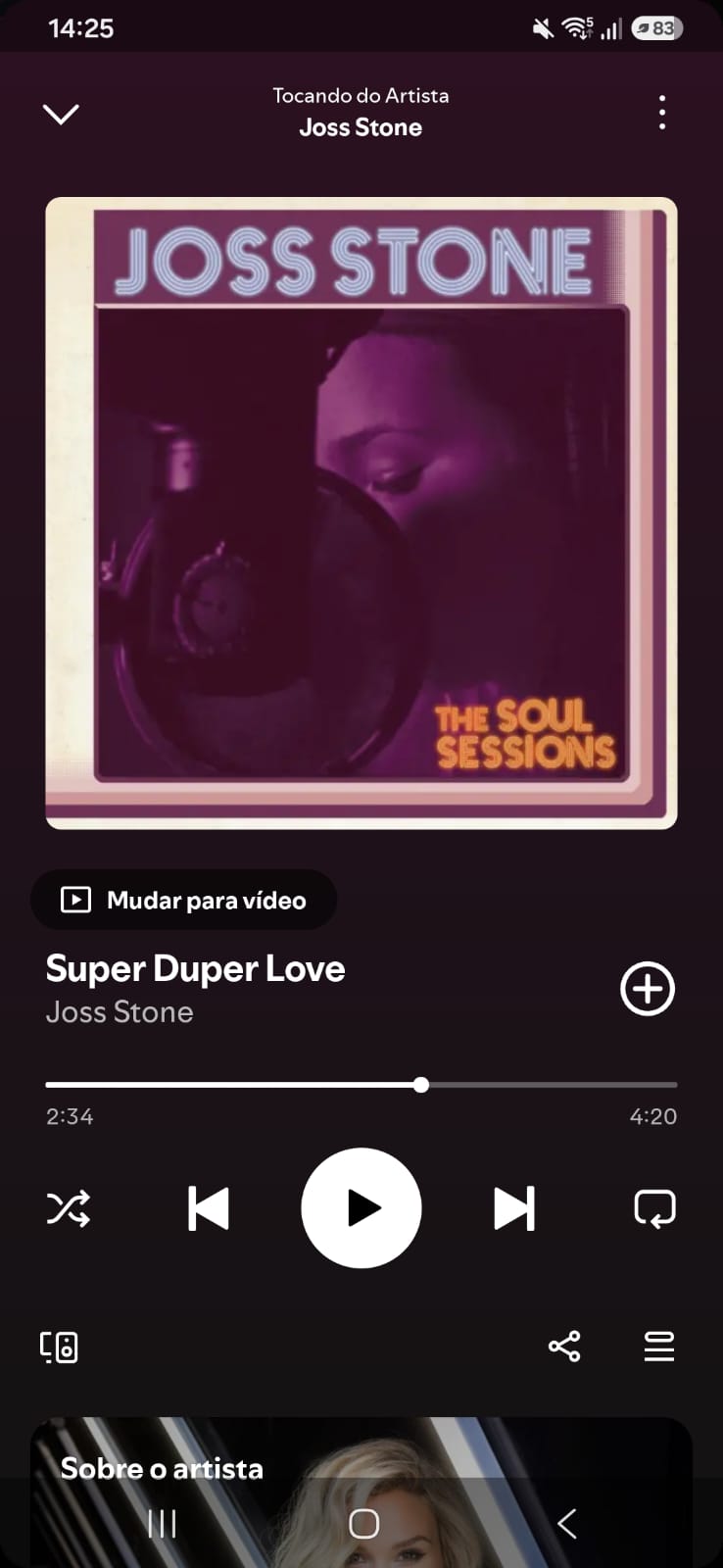
Joss Stone was only 16 years old when she recorded The Soul Sessions, but listening to “Super Duper Love” you would never guess it. The voice sounds like somebody who had already spent decades listening to soul records, and that was basically the point of the whole album. Instead of trying to sound like a teenager making a pop record, Joss went backwards and recorded songs from the 1960s and 1970s with musicians who actually came from that world. “Super Duper Love” became one of the songs that introduced her to a much bigger audience.
The song was released as part of The Soul Sessions in 2003 and later as a single in 2004. In the UK it reached number 18, which is impressive considering that this was not really a conventional teenage pop song. It was soul, it had a very old-school groove and Joss was basically standing in the middle of all of it singing like she owned the place.
Joss Stone and The Soul Sessions
The Soul Sessions is an interesting debut album because it is not really a debut in the traditional sense. Instead of introducing the world to a collection of songs written by a young artist, Joss Stone recorded mostly covers of older soul material. The album reached number four in the UK and eventually went triple platinum there.
That decision says a lot about Joss Stone.
She was clearly more interested in the music than in trying to fit into whatever the current pop trend was. In the early 2000s there was plenty of manufactured pop and teenage pop stars everywhere. Then suddenly there was this young English girl with a huge soul voice singing songs connected to an older generation.
It could have gone terribly wrong.
Instead, it worked.
“Super Duper Love” was originally written by Willie Garner, and Joss Stone’s version was produced by Steve Greenberg and Betty Wright, with Michael Mangini also involved in production. Betty Wright also provided backing vocals. That list of musicians is basically a little history lesson in soul and R&B by itself.
Super Duper Love is not really a complicated song
The first thing that catches your attention is the groove.
The song does not need a huge production to make you move. There is a bassline, drums, percussion, organ, piano, guitars and a bunch of backing vocals surrounding Joss Stone’s voice. The instrumentation is busy enough to feel alive but not so busy that it gets in the way.
And Joss is clearly having fun with it.
The vocal delivery is playful. There are little pauses, questions, repetitions and moments where she almost sounds like she is talking to the person she is singing to rather than performing a carefully rehearsed pop song.
The whole “Are you diggin’ on me?” idea makes the song feel like a conversation.
That is probably one of the reasons it works so well.
There is nothing particularly complicated about the question. She is basically asking if the other person is interested. But the way the musicians respond to her creates the feeling of a band playing together in a room instead of a singer recording over a perfectly programmed backing track.
The recording credits include Jack Daley on bass, Cindy Blackman on drums, Timmy Thomas on organ, Benny Latimore on piano, Willie “Little Beaver” Hale and Angelo Morris on guitar, and Ignacio Nunez on percussion.
Talk nerdy to me
For beginner music producers, “Super Duper Love” is a good example of why groove can be more important than complexity.
The published arrangement is around 96 BPM and is built in a straightforward 4/4 framework. The chord material is simple enough that a beginner can follow it, but the musicians create movement through rhythm, accents and the way the instruments interact.
The bass and drums are particularly important here.
The bass does not simply sit underneath the song playing the root notes. It participates in the groove. The drums and percussion create little movements around the beat, while the organ and piano fill the spaces. The guitars add another layer without turning the song into a wall of sound.
This is one of those examples where the arrangement teaches something that a lot of modern productions sometimes forget: a simple musical idea can feel incredibly rich if the musicians playing it have enough personality.
You can play the right chords with the wrong groove and get a boring song.
You can play relatively simple chords with a great groove and suddenly everybody is moving.
“Super Duper Love” is very much in the second category.
Joss Stone becomes more than a soul revival act
After The Soul Sessions, Joss Stone released Mind, Body & Soul in 2004. That album was more of a proper introduction to her own songwriting and personality, and it gave her another major UK hit with “You Had Me.” The album reached number one in the UK.
Her career continued moving between soul, R&B, pop, blues and other influences. She released albums like Introducing Joss Stone, Colour Me Free!, LP1, Water for Your Soul and eventually returned to the concept of revisiting soul classics with The Soul Sessions, Vol. 2.
The interesting thing is that the young woman who sang “Super Duper Love” did not remain frozen in that retro-soul image.
She kept changing.
But “Super Duper Love” remains an important snapshot because it shows where the whole thing started. Before all the later albums, collaborations and different musical directions, there was this teenager singing old soul songs with a group of extremely experienced musicians.
More songs from Joss Stone
“Fell in Love with a Boy” is another interesting one because it takes a Jack White composition and puts it into the soul-pop universe of Joss Stone. It was also released from The Soul Sessions and reached number 18 in the UK, the same peak position as “Super Duper Love.”
“You Had Me,” meanwhile, represents a different phase of her career. It comes from Mind, Body & Soul and shows Joss moving further away from simply being the teenager with the giant soul voice and becoming an artist with a more established identity.
“Right to Be Wrong” is another example of that more mature side and became another UK charting single.
Why Super Duper Love still works
“Super Duper Love” is one of those songs that feels older than it actually is.
It was released in the early 2000s, but the sound is deliberately looking backwards. The organ, piano, guitars, backing vocals and loose groove could easily make you think you had found some forgotten soul record from another decade.
That is what makes it such a good introduction to Joss Stone.
The song does not try to convince you that she is cool. It does not need to. The musicians are having fun, the groove is infectious and the voice does all the heavy lifting.
And maybe that is why this song keeps finding its way into playlists years after its release. It has that rare quality where you do not have to be studying soul music to appreciate what is happening. You just press play and the groove does the rest.
“Super Duper Love” is basically Joss Stone saying, at 16 years old, that she had discovered an old musical world and was completely comfortable living inside it.
Not bad for a debut.